
Piano Trio No. 1: Elegy An emotional piece reflecting the irreversible descent into dementia, dedicated to my late father, Ivan Shapiro.
(Piano,
Violin and Cello).
Audio clip of Elegiac performed by Sue Collado, clarinet, Sasha von Dassow, cello, and Elizabeth Schaltenbrand, piano.
Audio clip of Elegy performed by Trio Chromos: Ismael Betancor, trumpet; Carlos Rivero, cello and José Luis Castillo, piano.
|
|
||||||||||||||


This Elegy was written shortly after the death of my father at the early age of 69, in the wake of his nine year bout with Alzheimer's disease. It is plaintive and lyrical, and although it uses a modern tonal sensibility, there is a romantic, late nineteenth century presence that informs much of the piece. In my mind, this Trio has moments that faintly echo the Brahms trios which my father adored throughout his life. The opening theme in the violin descends in a variety of ways, and the flow of the music attempts to cry out and fight against such decline. The middle of the piece brings a moving cello melody which swells upward and ultimately plays against the violin motive in an emotional plea. The piece ends with stillness, the quiet, lone voices of the instruments, and the acceptance of loss.
|
 |
Elegy is featured on the Trio Chromos 2007 CD,
Trumpet Colors, on Crystal Records 766. Click CD for more info. |
|
"... The melancholy falling theme of Alex Shapiro’s Elegy hints a little at Brahms. The plangent cello line is seconded by the trumpet and supported by the supple piano, which then picks up the mood and all three instruments conjoin in lyric reflection. It was written originally for the standard piano trio of violin, cello and piano... Enjoyable and never trivial... excellently realised by the trio – fine sound as well completes the pleasure." |

|
"...the Trio Chromos (Ismael Betancor, trumpet; José Luis Castillo, piano; Carlos Rivero, cello) plays with utter abandon in these works, fully convinced of their authenticity and importance, and with all of the requisite skill and stylistic manners needed to successfully convey the music’s spirit."
|
|

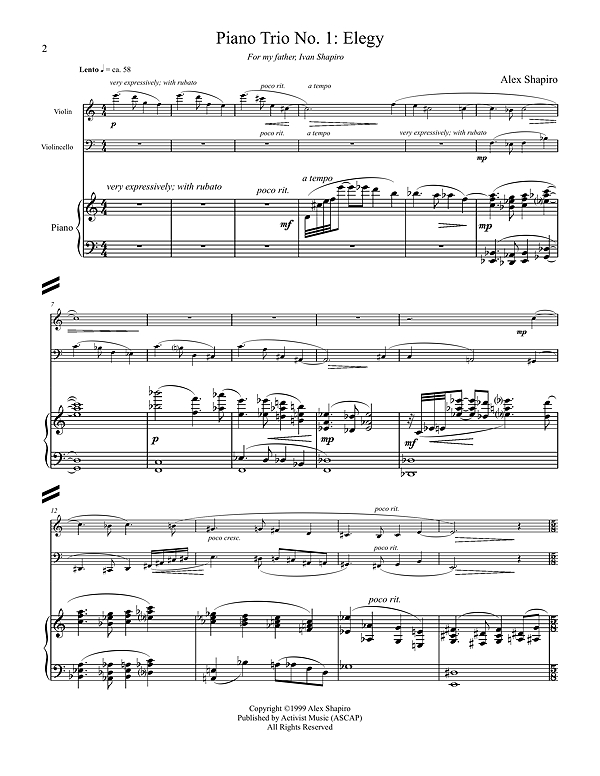
| Elegy, page 1 |
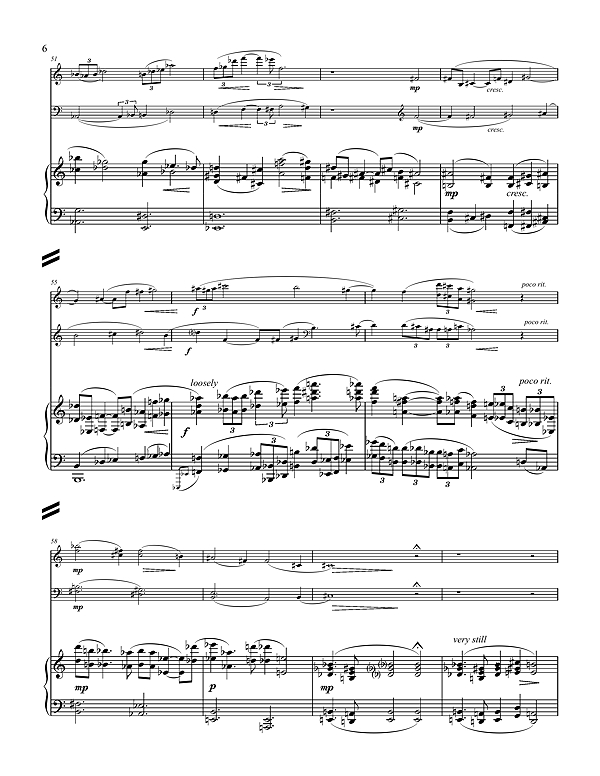
| Elegy, page 6 |
Also available as: Elegy
Premiered on September 17, 2004 in Spearfish, SD by The Orenunn Trio:
Recorded by Trio Chromos: Ismael Betancor, trumpet; Carlos Rivero, cello and José Luis Castillo, piano.
Audio clip performed by Trio Chromos: Ismael Betancor, trumpet; Carlos Rivero, cello and José Luis Castillo, piano.
Also available as:
Elegiac
Premiered on June 26, 2010 in Friday Harbor, WA by Chamber Music San Juans: Patricia Kostek, clarinet, Doug Davis, cello, and Arthur Rowe, piano.
|
|

© 2000-2024 by Alex Shapiro. All rights reserved to design and content.